Up to 84% Growth! Interpretation of Domestic Major Chemical Products Production Data from January to July 2026
From January to July 2026, domestic production of major chemical products showed structural divergence. Production of new energy supporting chemicals and lithium battery materials increased significantly, while output of basic petrochemical commodities such as ethylene, methanol, PX, and pure benzene grew moderately. Sectors including traditional resins, general-purpose plastics, and polyester synthetic fibers saw year-on-year declines in production, driven by high costs and weak downstream demand under geopolitical influences, prompting manufacturers to proactively reduce capacity. The fundamental reason for the divergent supply-demand landscape lies in differences in the prosperity of downstream industries. Procurement, production, and inventory strategies can be adjusted based on the distinct characteristics of different sectors.
From January to July 2026, the growth rates of various chemical products showed significant divergence. Among them, lithium iron phosphate, lithium carbonate, propylene glycol, dimethyl carbonate, and other battery and new energy supporting materials saw among the highest year-on-year increases, with most products experiencing growth exceeding 20%. Hydrogen peroxide, BOPA, octanol, and epichlorohydrin, among other fine chemicals, also maintained double-digit growth. Ethylene, methanol, pure benzene, PX, and other basic petrochemical commodities maintained slight positive growth, with overall supply remaining stable. In contrast, PTA, polypropylene, caprolactam, unsaturated resins, and maleic anhydride, which belong to polyester, general-purposAs foundational raw materials in the petrochemical industry chain, supply fluctuations directly reflect the overall production rhythm of the refining and chemical sectors. In the first half of the year, large-scale integrated refining and chemical facilities in China experienced a temporary decline in operating capacity due to events in the Middle East, but overall supply remained stable. Lacking support from traditional end-users, only new energy, new materials, automotive components, and high-end plastics contributed minor incremental growth. Consequently, production of most commodities maintained low-level growth.e plastics, and traditional resin categories, experienced year-on-year declines. Overall, changes in the supply side are more influenced by downstream orders, leading companies to proactively adjust production capacity, with the strength of end-demand becoming the core variable determining production trends.
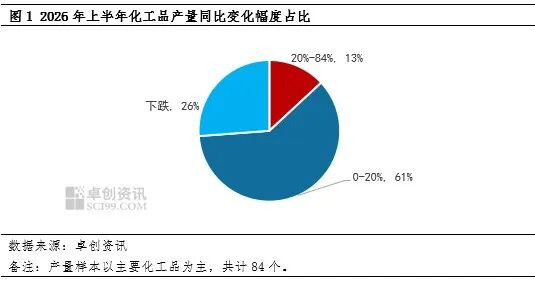
High Growth: The new energy supporting industry chain is expanding, with lithium battery materials and fine solvents showing remarkable growth in production.
From January to July 2026, chemical products with significant year-on-year production growth were primarily concentrated in the new energy support sector. Lithium battery upstream materials, battery solvents, and novel fine additives became the core drivers of this growth. Data shows that the production of lithium iron phosphate from January to July increased by 84% year-on-year, lithium carbonate rose by 44%, dimethyl carbonate grew by 37%, while propylene glycol and ethylene glycol monobutyl ether also saw increases of 40% and 41% respectively, making them commodities with high market growth elasticity.
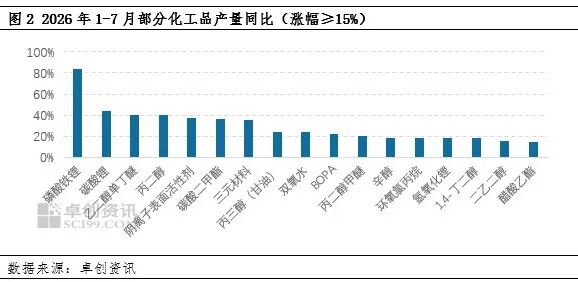
From the perspective of demand sectors, the continuous expansion of the energy storage industry and the increasing demand for new energy vehicle components have directly driven up the demand for positive electrode materials such as lithium salts and lithium iron phosphate. The additional production capacity of industrial chain supporting enterprises is gradually being released, with output also experiencing significant growth. Dimethyl carbonate, as a core solvent for lithium battery electrolytes, has seen sustained increases in downstream demand, keeping plant operations at high levels. Ether-based products and additives such as propylene glycol, ethylene glycol monobutyl ether, and anionic surfactants, in addition to supporting auxiliary battery materials, are also meeting growing demands in fields like new energy coatings and new materials for daily chemical products. Under the support of downstream orders, companies continue to increase their production capacity.
In addition, fine chemical raw materials/products such as hydrogen peroxide and BOPA film maintained growth of over 20%. Hydrogen peroxide is widely used in the purification of new energy materials and high-end chemical synthesis as supporting products for fine chemicals; BOPA film, serving as a substrate material for lithium-ion battery soft packages and food packaging, has seen its production steadily increase alongside the growing demand for new energy packaging. This indicates that the growth characteristics of fine chemical products are relatively consistent, with downstream applications mostly belonging to emerging growth sectors. The demand growth is sustainable, industry profitability remains relatively stable, and enterprise production enthusiasm is high.
Steady volume increase: Slight growth in basic chemical products, ensuring support from essential demand.
The production of core petrochemical products, including methanol, ethylene, pure benzene, PX (para-xylene), and ethylene glycol, showed a moderate and slight increase from January to July 2026, with growth rates generally ranging between 0% and 15%. Even with expectations of reduced crude oil imports due to the geopolitical conflict in the Middle East, bulk chemical products are primarily focused on maintaining stable production. Data from Red Heart 3 shows that from January to July, ethylene production increased by 9% year-on-year, methanol by 7%, pure benzene by 2%, and ethylene glycol by 4%.
As foundational raw materials in the petrochemical industry chain, supply fluctuations directly reflect the overall production rhythm of the refining and chemical sectors. In the first half of the year, large-scale integrated refining and chemical facilities in China experienced a temporary decline in operating capacity due to events in the Middle East, but overall supply remained stable. Lacking support from traditional end-users, only new energy, new materials, automotive components, and high-end plastics contributed minor incremental growth. Consequently, production of most commodities maintained low-level growth.
Decline in Production: Output of general-purpose plastics and traditional resins has decreased, with weak demand from traditional end-use sectors.
In stark contrast to the new energy sector, production of unsaturated resins, traditional plastics, polyester synthetic fibers, and other commodities has declined year-on-year, with some highly processed fine chemical products showing significant drops. Data from Red Heart 3 shows that from January to July, the output of unsaturated resins fell by 30% year-on-year, nylon short fibers dropped by 22%, PP powder decreased by 21%, and maleic anhydride and epoxy resin declined by 12% year-on-year. PP, PA6, caprolactam, and PTA also experienced varying degrees of negative growth.
The core reason for the decline in production is that the recovery of demand from traditional end-users downstream has not met expectations. Unsaturated polyester resin, epoxy resin, and maleic anhydride are highly related to the building materials, coatings, and fiberglass fields. Weak demand from real estate and infrastructure support has led to a sustained supply-surplus market environment, resulting in insufficient long-term orders for enterprises and continuous contraction in production. The core downstream of the polyester chemical fiber industry is the textile and apparel sector. In the first half of the year, the textile industry faced high costs and weak domestic demand, with limited growth in export orders, directly suppressing the production of products such as PTA, polyester, PA6, and caprolactam. The downstream applications of polypropylene mainly include bulk cargo handling and transportation, food packaging, and sealing tape substrates. In the first half of the year, the circulation of bulk commodities and commercial orders were weak, compounded by high propylene raw material costs, leading polypropylene enterprises to operate at reduced capacity during this period.
Future Outlook and Key Areas of Focus
Based on production data from January to July 2026 and the demand situation in the industrial chain, the "polarized" pattern in the chemical industry is expected to continue into the second half of the year. The fundamental trends of different sectors will continue to diverge. In the new energy supporting lithium battery materials, electrolyte solvents, and new fine additives sectors, short-term downstream demands from energy storage and new energy vehicles still provide support, and production is likely to maintain a growth trend. However, the supply growth risks brought by new capacity additions warrant attention. The production operations of basic chemical products such as aromatics, ethylene, and methanol remain stable, with output expected to maintain slight growth. Attention should be paid to the disturbance risks caused by international crude oil and macro policy changes. For traditional resins, polyesters, and general-purpose plastics, before terminal demand shows substantial recovery, production is likely to follow demand, and phased supply contraction may present market opportunities. Overall, the development opportunities in the chemical products market are closely related to the differentiation of downstream terminal sectors. By combining the marginal changes in supply and demand, formulating differentiated strategies for procurement, production planning, inventory, and risk control can better match the future differentiated market environment.